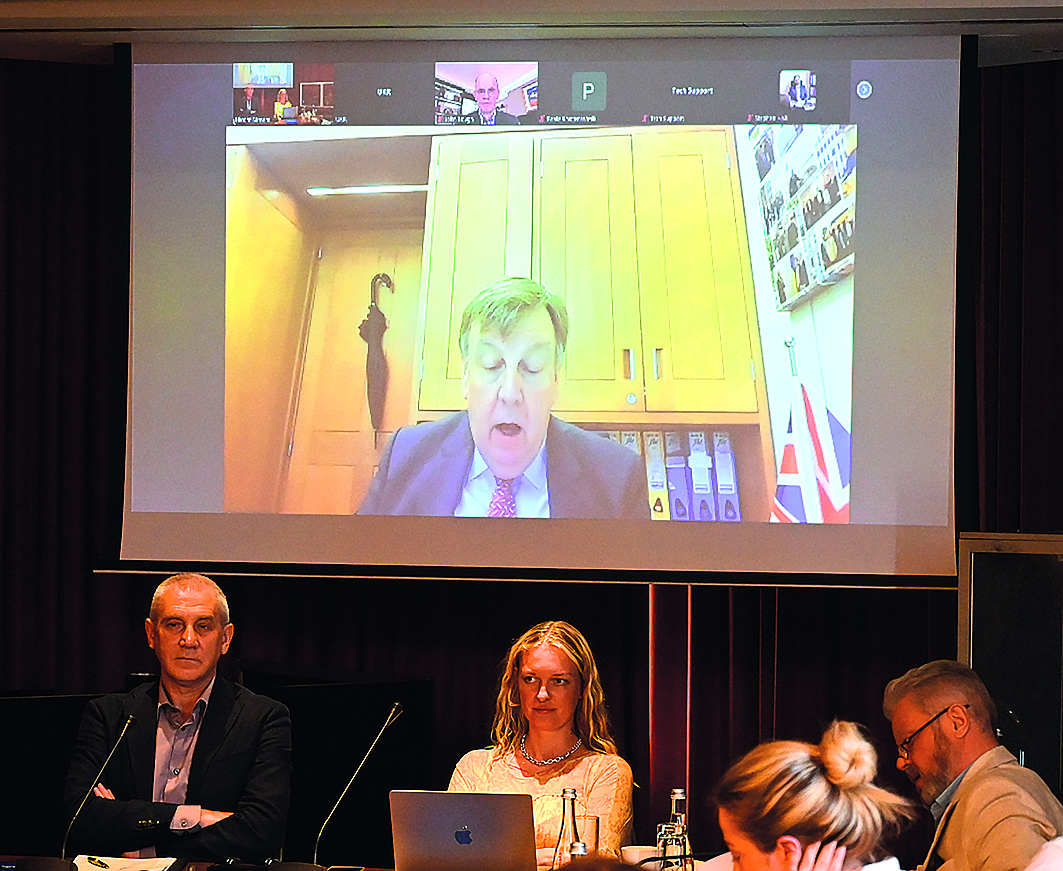
Based on the materials of the roundtable of the Institute for Global Politics “Russian Authoritarianism as a Threat to Global Security”
“Russia is waging an information war every day, not only in Ukraine, but throughout Europe, including the UK. And this war has many different forms”
My particular area of interest is the information war that is waged by Russia on a daily basis not only in Ukraine but throughout Europe, including the UK. And this war has many different forms.
One of the topics that we discussed with members of the Verkhovna Rada of Ukraine is the use of the Russian Church as a propaganda mouthpiece by the Russian government. And this is observed not only in Ukraine, but also in other former Soviet republics where the Russian Orthodox Church still has a strong position. And this is a challenge, because people believe in freedom of religion, without realizing that in fact the church is in some cases used simply as a propaganda tool.
I am also familiar with how traditional media are used. For example, in the UK, we have now stopped broadcasting RT and Sputnik because they simply spread Russian propaganda and do not represent objective journalism. But this is happening most actively on the Internet, on social media, where the level of sophistication in the use of technology is growing, both on the part of Russia and on our part in countering this. That is why I have had talks with representatives of a number of countries that are cooperating in solving this problem.
A few weeks ago, I was in Moldova, where there is a huge attempt by Russia to influence the parliamentary elections. They are using channels such as Telegram, TikTok and, of course, other channels that are more familiar to us. But we are talking about elections in September, in just 6 weeks. And there is a real risk that Russia will use disinformation to influence what is likely to be a close election.
 Internationally, a lot of work has been done by organizations like Vigilance in France. They have developed very advanced methods to detect Russian attempts to use social media for what we now call FEMI, which is information manipulation and interference, or disinformation, if you prefer that term. They first identified the Doppelganger network, which was a whole set of Russian attempts to create bots and websites to spread artificial, false information. Recently, Storm 1516 appeared, which is another version of a more sophisticated version, aimed in particular against Ukraine. How can we counteract this? We do it through fact-checking and verification. Although, Russia has also become more sophisticated in its attempts to destroy legitimate news sources and claim that it is disinformation. So there’s an ongoing struggle there.
But the area that I’ve been most involved in during my time in the UK government and internationally is supporting professional media, which is the best source of information. Now, Russia is obviously trying to hamper journalism. That is why so many journalists have been killed or imprisoned in Russia.
Russia is also trying to block sources of information from the West. In the UK, we have the BBC World Service, which is probably one of the most reliable and influential international broadcasters. I visited the Russian service, which now has to be based in Latvia. I saw that the journalists are doing a great job. They also use social media. But other voices are probably partly silenced by the US administration’s decision to cut off funding for organizations like Voice of America and other independent media.
In Ukraine, some of the most important reporting is done by small independent media outlets and their journalists, who show great courage by going to the scene and telling what is happening there, recording Russian war crimes, reporting what is really happening on the front line. These are first-hand reports, as they say. But they depend on funding, which is not available. So I would probably subscribe to one or two channels. It is extremely important to counteract the huge amount of disinformation coming from Russia. We have been doing everything we can to support independent journalism, to ensure that people have access to objective, factual, verified reports, which is the task of traditional media.
Now I’m investigating disinformation, but I also communicate with Ukrainian politicians, including those on the front lines. I have close relations, in particular, with the Baltic States. They are also subject to the same amount of disinformation. I think this is one of the most important aspects of the current conflict, not only between Russia and Ukraine, but between Russia and all developed Western democracies.
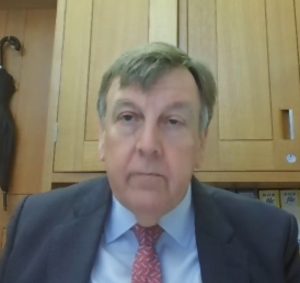
John Whittingdale
Member of Parliament of the United Kingdom
of Great Britain and Northern Ireland